


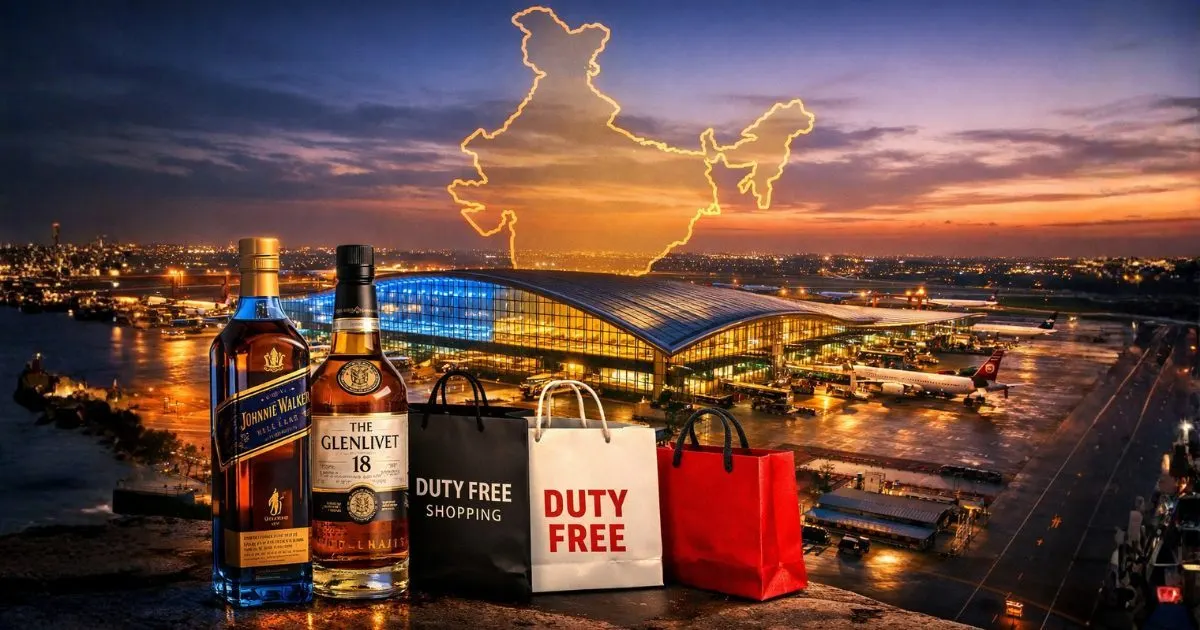
Duty free India is at a genuine inflection point. India’s landmark Free Trade Agreement with the United Kingdom has been described as one of the most consequential economic pacts in recent decades. Among the many trade categories affected the premium spirits and duty free retail sector stands out as a space where real transformation and real complexity will unfold simultaneously.
Table of Contents
- 1. What Is the India UK FTA? A Quick Overview for Duty Free India Operators
- 2. How Scotch Whisky Tariffs Will Change Under the FTA and What It Means for Duty Free India
- The Gap Between Tariff Cuts and Duty Free India Consumer Prices
- 3. Why State Excise Taxes Limit Duty Free India Price Pass Through
- Why States Cannot Simply Pass On FTA Benefits to Duty Free India Consumers
- 4. Airport Hub Dynamics: Delhi, Mumbai, Bengaluru, Kochi and Hyderabad for Duty Free India
- 5. Duty Free India vs Downtown Retail: What Price Difference Can Travellers Expect?
- The Two Price Advantages Driving Duty Free India Savings
- 6. Strategic Imperatives for Duty Free India Operators Under the FTA
- Pricing and Category Architecture for Duty Free India
- Consumer Communication in Duty Free India
- Brand Level Margin Protection
- Policy Engagement for Duty Free India
- 7. State Excise Revenue Data: The Fiscal Reality Behind Duty Free India Headlines
- 8. Frequently Asked Questions About Duty Free India and the India UK FTA
- Will Scotch whisky become cheaper in duty free India after the FTA?
- Why is duty free India Scotch cheaper than buying it in a city shop?
- Which Indian airports offer the best duty free India prices on Scotch whisky?
- How much Scotch can I bring into India duty free from abroad?
- Will the India UK FTA benefit Indian whisky exports to the UK?
- Why do different Indian states have such different alcohol prices at duty free India airports?
- What should duty free India operators do differently because of the FTA?
- When will the full FTA tariff reductions take effect for duty free India?
- Are gin and other UK spirits also covered by the FTA tariff reductions?
- What does the India UK FTA mean for luxury goods and cosmetics in duty free India?
- 9. Conclusion: Navigating the New Duty Free India Landscape After the FTA
- Sources
This comprehensive guide breaks down exactly what the India UK FTA means for duty free pricing at India’s major airports, how state excise tax structures complicate the headline tariff story and what strategic moves brands and operators must make to capitalise on this shift in 2025 and beyond.
Whether you are a Scotch whisky brand manager, a travel retail operator, an investor or a frequent flyer curious about whether you will pay less for that bottle of single malt at Mumbai airport, this article answers your questions with data, analysis and actionable insight.
1. What Is the India UK FTA? A Quick Overview for Duty Free India Operators
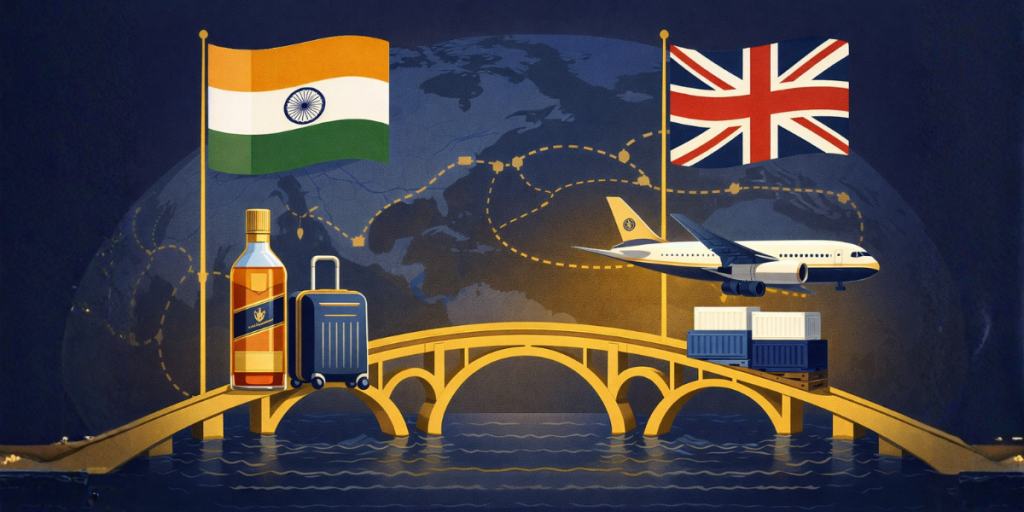
The India UK Free Trade Agreement represents a sweeping bilateral pact that restructures tariff and trade conditions across hundreds of product categories. The headline numbers for importers are striking and their implications for duty free India are significant.
India will reduce tariffs on 90% of UK goods with 85% of those eventually becoming entirely tariff free over a decade. Scotch whisky and gin tariffs will drop from approximately 150% to around 75% immediately upon implementation and fall further to approximately 40% by Year 10. India in turn gains duty free access for 99% of its exports into the UK, benefiting textiles, gems and jewellery, pharmaceuticals and engineering goods.
For the travel retail and premium spirits ecosystem the FTA is significant. However the actual consumer impact is far more nuanced than headline tariff figures suggest and that is a critical point this article unpacks in depth.
Related: How AI Is Reshaping Duty Free Retail in India
2. How Scotch Whisky Tariffs Will Change Under the FTA and What It Means for Duty Free India
To understand the pricing implications for duty free India it helps to track the tariff journey across the phased implementation period. The table below maps each milestone to its consumer price impact.
| Milestone | Scotch Tariff | Gin Tariff | Consumer Price Impact |
|---|---|---|---|
| Pre FTA (Current) | ~150% | ~150% | Baseline pricing for duty free India spirits |
| FTA Year 1 (Immediate) | ~75% | ~75% | Rs 100 to Rs 300 per bottle reduction |
| FTA Year 5 | ~55 to 60% | ~55 to 60% | Moderate broadening of duty free India savings |
| FTA Year 10 (Full) | ~40% | ~40% | Greater but still partial consumer benefit |
The Gap Between Tariff Cuts and Duty Free India Consumer Prices
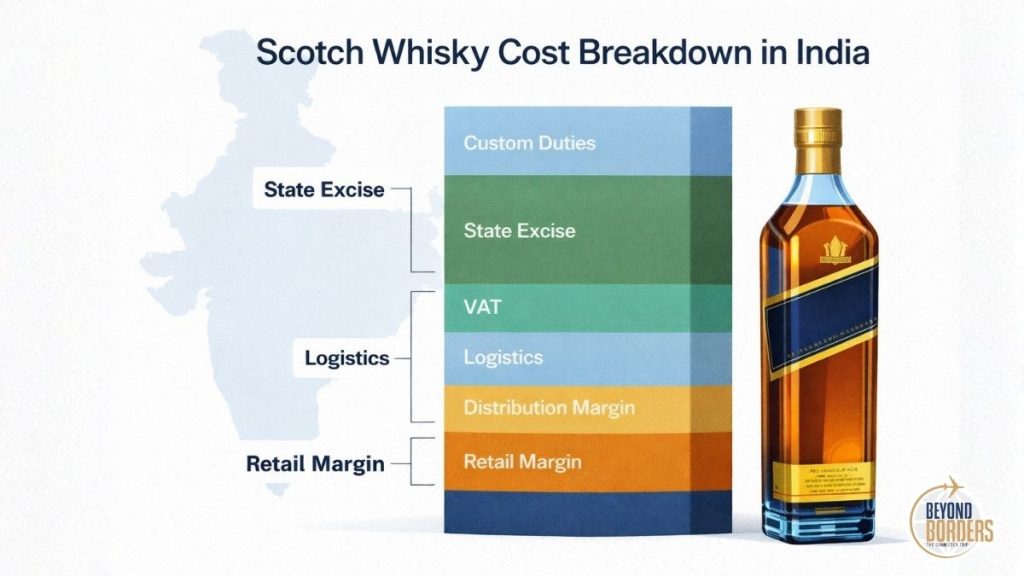
The key insight here is the gap between the tariff cut and the consumer price impact. Even a 75 percentage point reduction in customs tariff translates to only a modest retail price change because customs duty represents only 10 to 15% of the total shelf price. The dominant cost components of state excise, VAT, logistics and distribution margins remain untouched by the FTA.
This is why duty free India retains a structural pricing advantage even as domestic retail prices edge down. The absence of state excise at the point of sale in a duty free zone is a more powerful pricing lever than any tariff reduction the FTA delivers.
3. Why State Excise Taxes Limit Duty Free India Price Pass Through
India’s alcohol taxation structure is unique. Unlike most consumer goods, alcohol is excluded from the Goods and Services Tax framework. Instead excise duty, VAT and licensing fees are levied and controlled at the state government level.
This creates a layered cost structure where the central government’s customs tariff is just one variable in a much larger equation dominated by state level fiscal decisions. The states have both the authority and the financial incentive to maintain their excise rates regardless of what the FTA achieves at the import level.
Why States Cannot Simply Pass On FTA Benefits to Duty Free India Consumers
Excise revenue accounts for 10 to 25% of state Own Tax Revenues in major states making it a primary fiscal pillar. States like Uttar Pradesh and Karnataka derive 20 to 24% of their own tax revenue directly from alcohol excise. Any reduction in excise rates to reflect FTA tariff benefits would require states to find alternative revenue sources which is a politically and fiscally complex undertaking. The result is that even where central tariffs fall sharply, state level levies ensure the consumer price of premium Scotch in domestic retail drops only marginally.
Related: State Excise and Pricing Strategy in India Airport Retail
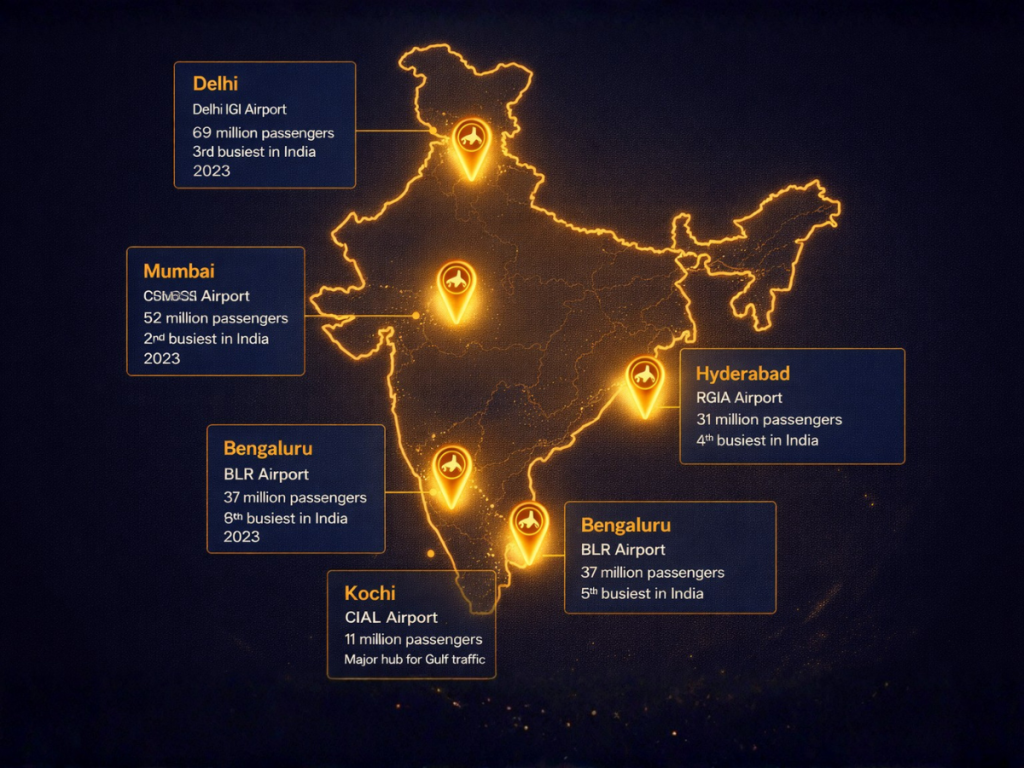
4. Airport Hub Dynamics: Delhi, Mumbai, Bengaluru, Kochi and Hyderabad for Duty Free India
India’s five primary duty free India hubs each present a distinct pricing environment, passenger profile and strategic opportunity. Understanding these differences is essential for operators deploying airport specific retail strategies.
| Airport | Passenger Mix | Duty Free India Opportunity | Excise Impact | Strategy Focus |
|---|---|---|---|---|
| Delhi (DEL) | Largest international traffic | High premium demand | Excise dampens savings | Volume and premium mix |
| Mumbai (BOM) | Business and international leisure | Strong luxury segment | High excise limits edge | Ultra premium brands |
| Bengaluru (BLR) | Fast growing outbound | Rising premium appetite | Karnataka high excise | Emerging affluent travellers |
| Kochi (COK) | Regional and NRI traffic | Strong spirits demand | Kerala excise hinders | NRI gifting occasions |
| Hyderabad (HYD) | Corporate and leisure | Growing premium category | Telangana limits effect | Corporate gifting and loyalty |
The diversity of these hubs underscores why a single pricing or marketing strategy will be ineffective for duty free India. Operators must calibrate their approach to the excise realities, traveller demographics and purchase motivations specific to each airport.
5. Duty Free India vs Downtown Retail: What Price Difference Can Travellers Expect?
One of the most searched questions around the India UK FTA is simple: will my bottle of Scotch at a duty free India airport be cheaper after the deal? The answer is nuanced and it hinges on understanding two separate pricing advantages that often get conflated.
The Two Price Advantages Driving Duty Free India Savings
First there is the FTA customs tariff reduction which as discussed will result in a modest Rs 100 to Rs 300 per bottle drop in domestic retail pricing over time and will be most visible in lower excise states.
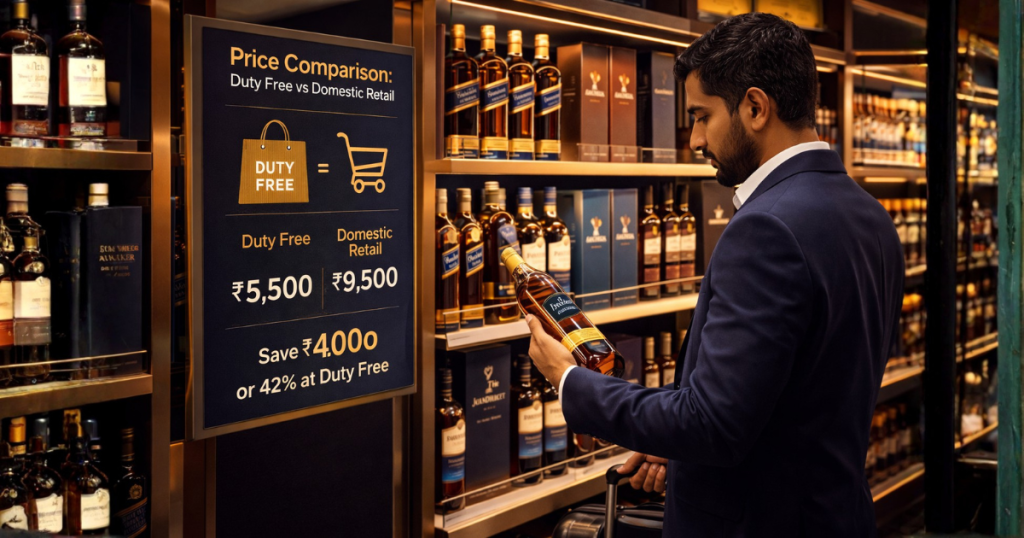
Second and more powerfully for travellers, duty free India retail has always operated outside the state excise structure entirely. At the point of sale in a duty free India zone the buyer does not pay state excise or VAT which are the largest cost components for domestic retail buyers. This means that duty free India can and should maintain a clear price advantage over downtown retail not because of the FTA alone but because of the structural absence of state levies at the point of sale.
In high excise states like Karnataka, Maharashtra and Uttar Pradesh the duty free India price advantage over domestic retail remains substantial. In lower excise states like Goa the price differential between duty free India and local retail is less dramatic but still present. After the FTA takes effect domestic retail prices will edge down which means duty free India operators must continue to invest in value communication to maintain perceived advantage.
6. Strategic Imperatives for Duty Free India Operators Under the FTA
The India UK FTA introduces both opportunity and competitive pressure for duty free India operators. Those who adapt proactively stand to capture significant growth and those who rely on automatic tariff driven benefits risk seeing margins compress without commensurate volume gains.
Pricing and Category Architecture for Duty Free India
Segment offerings between FTA benefit SKUs such as Scotch and gin versus core domestic lines to preserve category clarity in duty free India. Develop exclusive travel retail editions, gift packs and curated bundles to create purchase occasions that are immune to direct price comparisons.
Consumer Communication in Duty Free India
Deploy transparent value messaging that compares duty free India prices with the equivalent state retail price as the saving is most visible when the state excise regime is made explicit. Localise campaigns to reflect the specific pricing advantage context of each duty free India airport hub.
Brand Level Margin Protection
Prioritise the premium and ultra premium segments where consumer price sensitivity is lower and brand story commands the transaction. Replace across the board price cuts with experiential incentives such as tasting events, loyalty reward integration, personalised engraving and exclusive bottlings.
Policy Engagement for Duty Free India
Engage proactively with state excise authorities to establish frameworks that enable partial pass through of FTA benefits without threatening state fiscal stability. Contribute data and analysis demonstrating the incremental value of duty free India travel retail revenue to state economies.
Related: The Beyond Borders Travel Retail Manifesto: Five Forces Shaping the Next Decade
7. State Excise Revenue Data: The Fiscal Reality Behind Duty Free India Headlines
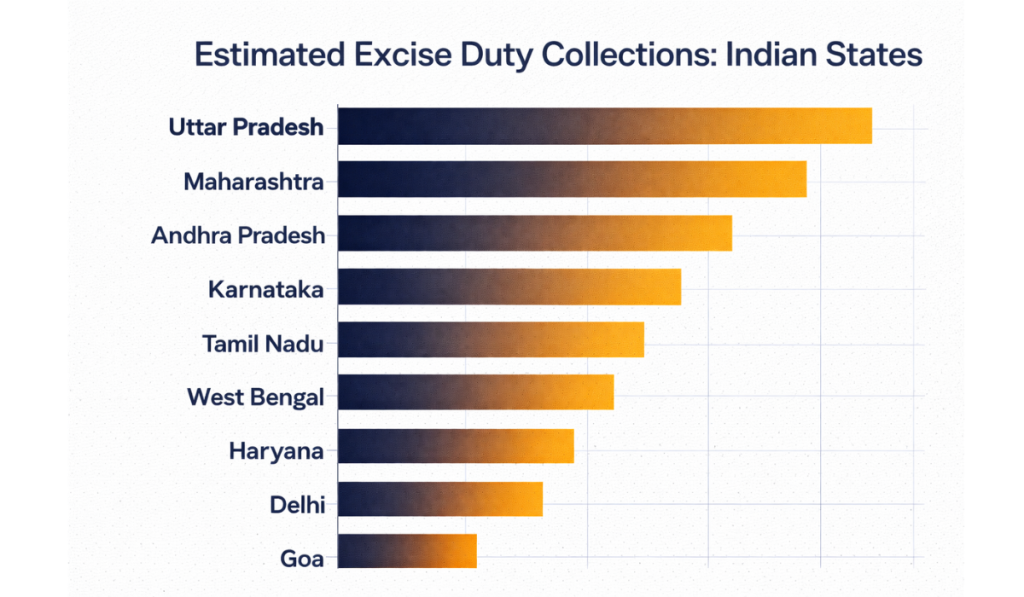
The following table provides estimated excise duty collections by state for FY 2023 to 2024 alongside the share of that revenue as a proportion of each state’s own tax revenues. This data is essential for understanding why price pass through from tariff reductions is structurally limited in most of India’s major alcohol consuming states and why duty free India retains its pricing advantage.
| State / UT | Est. Excise Collection (Rs Crore) | Excise as % of Own Revenue | Key Note |
|---|---|---|---|
| Uttar Pradesh | ~Rs 39,600 | ~23 to 24% | Largest single excise base in India |
| Maharashtra | ~Rs 37,000 | ~9 to 10% | Large population with diversified tax base |
| Andhra Pradesh | ~Rs 27,000 | ~11 to 12% | High excise in a fiscal deficit context |
| Karnataka | ~Rs 19,500 | ~20 to 21% | Deeply embedded excise regime |
| Tamil Nadu | ~Rs 17,000 | ~6 to 7% | State run distribution model |
| West Bengal | ~Rs 11,300 | ~18 to 19% | Strong reliance on excise revenue |
| Haryana | ~Rs 11,000 | ~15 to 16% | Moderate excise dependency |
| Delhi (UT) | ~Rs 5,500 | ~14 to 15% | Urban consumption driven |
| Goa | ~Rs 700 | ~9 to 10% | Small base with tourism influence |
Source: Publicly reported and aggregated state excise collections data from various Indian financial reporting sources and RBI state finance analyses. Figures are estimates for FY 2023 to 2024.
8. Frequently Asked Questions About Duty Free India and the India UK FTA
Will Scotch whisky become cheaper in duty free India after the FTA?
Yes but modestly. Customs duties on Scotch will halve immediately from around 150% to approximately 75% and eventually reach 40% by Year 10. However because customs duty represents only 10 to 15% of the total retail price the actual price reduction at the shelf is projected to be around Rs 100 to Rs 300 per bottle which is roughly an 8 to 15% reduction. State excise taxes which form the bulk of the final price remain unchanged. Duty free India retains its structural advantage because it already operates outside the state excise framework.
Why is duty free India Scotch cheaper than buying it in a city shop?
Duty free India retail at international airports operates outside the state excise and VAT framework that applies to domestic retail. When you buy at a duty free India shop you avoid the state level levies that can add 50 to 100% to the domestic retail price in high excise states. This structural advantage exists independently of the FTA and is the primary reason duty free India prices are lower than downtown alternatives.
Which Indian airports offer the best duty free India prices on Scotch whisky?
All major international airports including Delhi, Mumbai, Bengaluru, Kochi and Hyderabad operate duty free India stores where state excise is not applied. The relative price advantage over local retail varies by state excise regime. High excise states like Karnataka and Maharashtra produce larger gaps between duty free India and downtown prices making those airports particularly attractive for spirits purchases.
How much Scotch can I bring into India duty free from abroad?
Travellers returning to India are permitted to bring up to 2 litres of alcohol as part of their duty free allowance under current customs rules. This applies to spirits including Scotch whisky and gin. Quantities beyond this allowance are subject to customs duty at the applicable rate which will decrease under the FTA over time.
Will the India UK FTA benefit Indian whisky exports to the UK?
Indian spirits particularly Indian Single Malt whisky stand to benefit indirectly as the FTA improves India’s overall trade relationship with the UK. While the most immediate tariff headlines focus on Scotch coming into India, Indian brands gain duty free access for 99% of their exports into the UK. This could support premium Indian spirits reaching British consumers at more competitive price points.
Why do different Indian states have such different alcohol prices at duty free India airports?
Each Indian state government sets its own excise duty rates, VAT and licence fees on alcohol independently as the product is excluded from the national GST framework. States treat alcohol excise as a key revenue source. In some states it accounts for over 20% of Own Tax Revenues. The result is that a bottle of the same Scotch whisky can vary by hundreds of rupees in retail price depending on which state you are buying it in. Duty free India airports operate outside this framework entirely.
What should duty free India operators do differently because of the FTA?
Duty free India operators need to sharpen value communication by showing travellers explicitly how much they are saving compared to equivalent domestic retail in the traveller’s home state. They should invest in exclusive travel retail editions, experiential add ons and loyalty integration rather than relying on automatic price advantages. Airport specific strategies tailored to each duty free India hub’s passenger profile and excise context will be essential.
When will the full FTA tariff reductions take effect for duty free India?
The FTA is structured as a phased implementation over ten years. The most significant initial cut from approximately 150% to 75% takes effect in Year 1 upon formal implementation. Subsequent reductions follow a phased schedule and reach the targeted floor of approximately 40% by Year 10. Duty free India operators and brands should plan around a gradual trajectory rather than a single step change.
Are gin and other UK spirits also covered by the FTA tariff reductions?
Yes. The same tariff reduction trajectory that applies to Scotch whisky also applies to gin and other UK origin spirits. This has implications beyond just whisky for duty free India. Premium London Dry gin, craft gins and other categories will progressively become more price accessible in India’s domestic market and benefit duty free India pricing dynamics as well.
What does the India UK FTA mean for luxury goods and cosmetics in duty free India?
The India UK FTA’s tariff liberalisation extends beyond spirits to cover a wide range of UK exports including cosmetics, luxury goods and fashion. For duty free India this broadens the category opportunity for UK origin products across all premium segments. Operators with diversified premium assortments stand to benefit from improved landed costs and potentially stronger price positioning versus domestic alternatives.
9. Conclusion: Navigating the New Duty Free India Landscape After the FTA
The India UK Free Trade Agreement marks a genuine inflection point for the premium spirits and duty free India travel retail sector. The tariff reductions on Scotch whisky and gin are meaningful but they are the beginning of a complex story and not its conclusion.
The real competitive landscape for duty free India will be shaped by state excise realities, airport specific passenger dynamics and the strategic choices that brands and operators make in the months immediately following implementation. Duty free India’s structural advantage of freedom from state level levies remains the sector’s most powerful differentiator and one that no domestic retailer can replicate.
The operators and brands that will win in duty free India are those who combine data driven pricing transparency, differentiated product assortments and airport specific strategies. This is a moment for strategic leadership and not reactive pricing adjustments. The duty free India inflection point is here and the question is who is positioned to capitalise on it.

Sources
- Reuters
- The New Indian Express
- Business Today
- Mint
- The Economic Times and RBI State Finance Data
Disclaimer: The analysis, opinions and projections expressed in this article are based on publicly available information and research. They are not intended as professional, legal or policy advice.